 Johnattan's Laboratory
A study site built from a course's recorded classes
The professor of a family-law course at a Colombian university records the classes and wanted a written guide for students. I built a pipeline that turns each recording into a reviewed study note with official sources, a narrated audio version and practice questions.

Updated13 Oct 2026
The problem
The professor of a family-law course at a Colombian university records the classes and wanted to write a guide text for the subject; the recordings were the way to start. I receive the audio, and I needed to turn hours of spoken class into study notes students can rely on: the concepts, the laws and the court rulings discussed, each linked to its official source, without identifying anyone in the room.
What I built
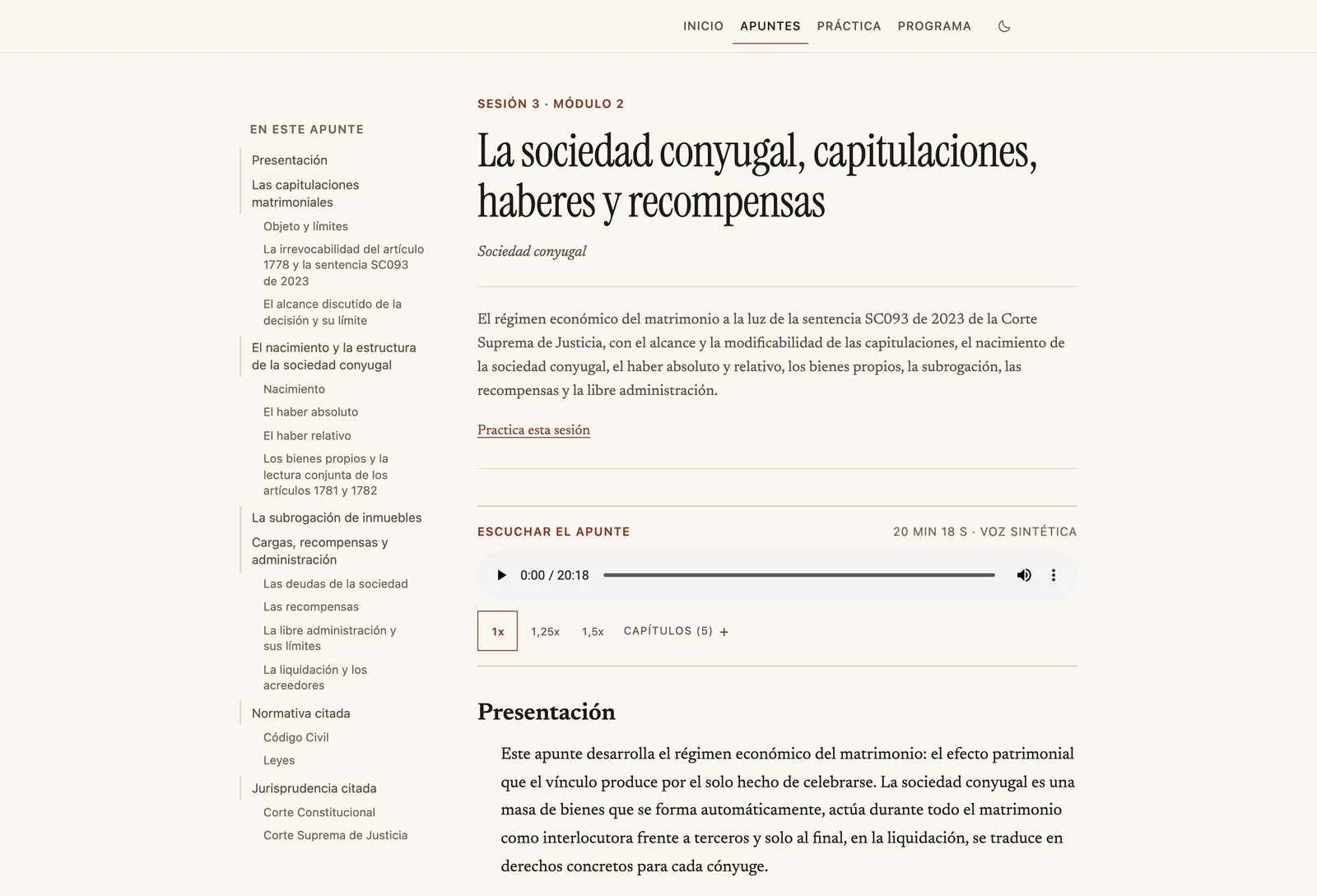
A small static website with one study note per session of the syllabus. The notes are called apuntes, not notas, because in Colombia a nota is a grade. They are written as doctrine, like a textbook chapter, not as minutes of the class: no chronology, no "a student said", and what came out of the discussion is folded into the explanation without attribution.
Each note has:
- Links to official sources for every law and ruling cited: the Constitutional Court's records, the government's legal database and an official compilation of the Civil Code with anchors per article.
- A narrated version in a Colombian Spanish neural voice, with a player that has speed control, chapters and a click on any paragraph to jump there. It works without JavaScript too.
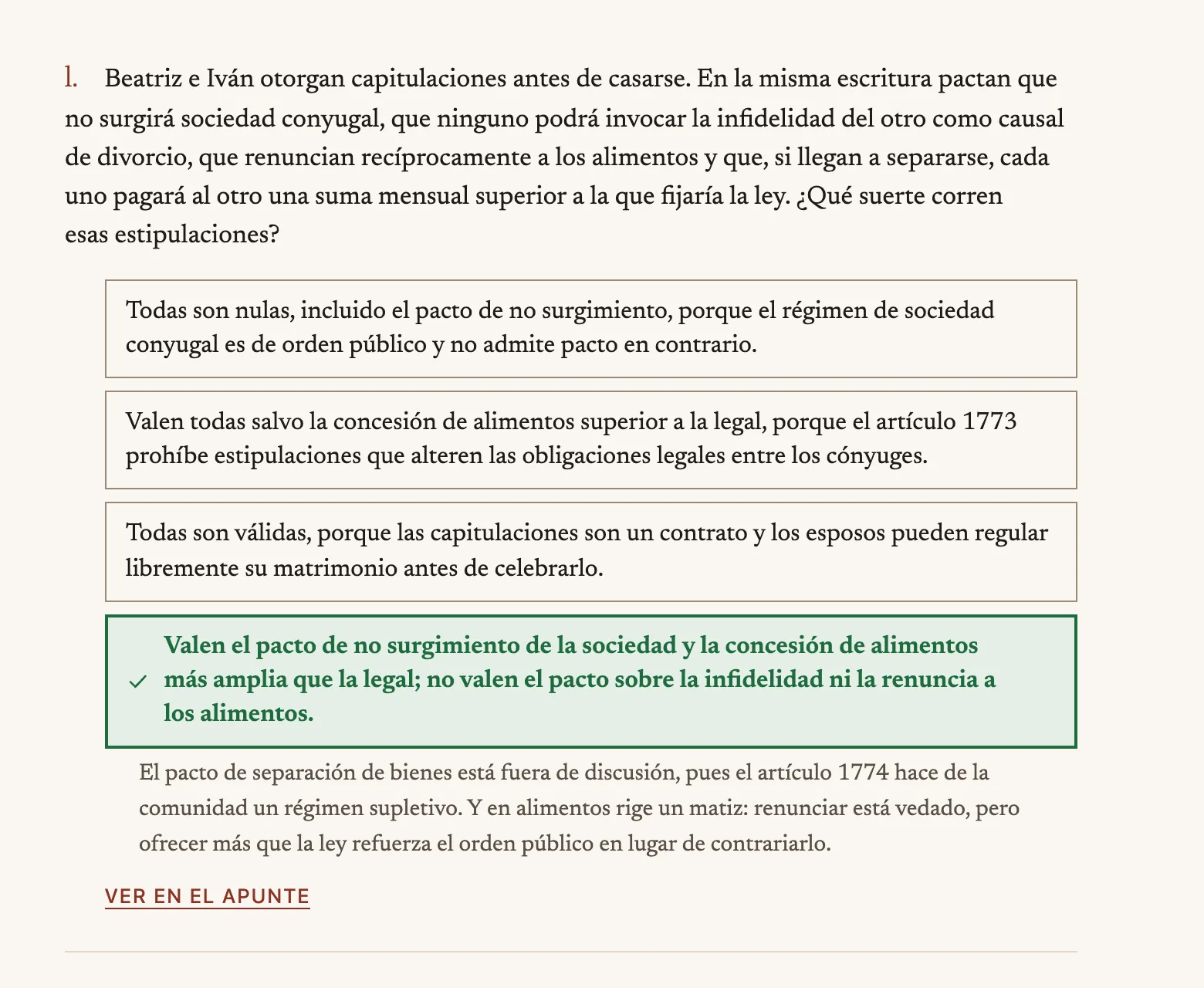
- A practice set of 10 multiple-choice questions and 2 short cases with variations, with immediate feedback and a final score. No answers or scores are stored, not even in the browser.
The site shows no dates (the course has two sections, so everything is organised by session number), no email addresses and no student names. Raw recordings and literal transcripts stay on my Mac and never enter the repository.
Equipment
- Mistral (Voxtral) AI models
- Claude Code Harnesses and agents
- Claude (Opus 4.6 to 5.5) AI models
- Codex CLI Harnesses and agents
- GPT (GPT-5.5 to GPT-6.1 in Codex) AI models
- edge-tts (Microsoft neural voices) Apps and services
- Python and uv Code and infrastructure
- Vercel Code and infrastructure
- GitHub and GitHub Pages Code and infrastructure
How I built it
- Transcribe each recording with Mistral Voxtral. A batch script handles several files and retries when the API returns a rate-limit error.
- Draft the note from the transcripts with a Claude Opus agent, against a fixed template, with links to official sources. Where both sections recorded the same session, one note combines both discussions.
- Check every article and ruling number against the source. Transcription gets them wrong systematically: article 113 came out as "103", and the ruling SU-214 of 2016 as "C1-2400-2016".
- Send the notes and question banks to Codex (GPT-6 Astra, high) for an independent legal review. Each finding is checked against the source before it is applied. Where a note corrects something said in class, the point is listed for the professor.
- Build the site with a Python generator that validates every note and practice file (each question must point to a real section of its note), generates the audio with a local cache, and deploys to Vercel. The professor approves each new practice set before it is announced to students.
Results
- 11 of the 32 sessions in the syllabus are published, with notes, audio and practice. Of the rest, some were not recorded or not received, and the others have not been taught yet.
- The 11 sessions hold 110 multiple-choice questions with 440 options, plus 22 short cases.
- The first note has about 2,400 words with 19 verified links to official sources; its narration runs 14:53 minutes (5.1 MB) in 53 blocks and 5 chapters. Later notes run 2,900 to 3,300 words.
- The independent legal review of the four latest notes found 26 issues in the notes and 12 in the question banks. All were verified against the source and applied except one, which flagged the name of the claimant in an Inter-American court case; I kept it because it is a legitimate legal citation.
- Mobile Lighthouse on a note page scores 100 for performance, with the largest content shown in 1.4 s and no layout shift (before: 69, 4.2 s and 0.165).
- The project has 105 automated tests.
- The professor approved the site, the first note, its voice and its practice set for sharing with students.
What I learned
Transcription fails on numbers. Article and ruling numbers came out wrong again and again, so every one is checked against the official text before a note is published.
The legal review by a second model caught more than slips: it found several points where what was said in class differs from current law. The notes follow the law, and those points go to the professor rather than being changed silently.
Free, unofficial services can stop working without notice. The text-to-speech library I use for narration stopped connecting in version 7.2.8; moving to 7.3.0 fixed it, and because the narration script is generated from the notes, all the audio could be rebuilt in one run.
Lab notes
-
I published four more sessions after an independent legal review by Codex found 26 issues in the notes and 12 in the question banks.
-
I applied the professor's approved corrections to the practice questions: 33 text revisions and one changed answer key.
-
The site reached seven published sessions, one of them built from the recordings of both sections of the course, after I applied the quick wins from an independent design audit by Codex.
-
Claude Opus drafted the first study note from a recorded class and I put the site online. The next day I added a narrated audio version of each note and a practice section, and mobile Lighthouse performance went from 69 to 100.