 Johnattan's Laboratory
Do constitutional rights to health go with better health? A test across 183 countries
Studies have reported that constitutional health rights go with better health, without correcting for the number of tests they ran. I reclassified the health provisions of 183 constitutions on a five-level scale and tested them against ten WHO and World Bank indicators, controlling for national income.

Updated29 Dec 2025
The problem
Many national constitutions promise health care, as a state duty, as an individual right, or as care free of charge. I wanted to know whether countries whose constitutions make those promises have better population health once national income is taken into account.
What was out there
The Comparative Constitutions Project (CCP), in which two independent coders read each constitution, codes the three health questions as yes, no or "other". That hides the difference between a firm guarantee, a provision for some groups only, an aspiration "within available resources" and a promise left to ordinary law. The cross-national studies I reviewed mostly reported positive associations with health (Ben-Bassat and Dahan 2008, Kavanagh 2016, Matsuura 2015 and 2019), with a null result for health spending (Chilton and Versteeg 2017). None of the studies in my literature table corrected for multiple comparisons.
What I built
I built a five-level classification of the health provisions in 183 constitutions in force in 2023, separately for the state duty to provide care, the right to health care and free care, and merged those levels with ten health and financing indicators. On that dataset sits a correlation analysis with income control, multiple-comparison corrections and regional breakdowns. The write-up is a manuscript draft plus a plain-language guide to its statistics for lawyers and human rights professionals.
Equipment
- Claude Code Harnesses and agents
- Codex CLI Harnesses and agents
- ChatGPT Apps and services
- Python and uv Code and infrastructure
- Comparative Constitutions Project Data sources
- WHO World Health Statistics Data sources
- World Development Indicators Data sources
How I built it
- Filtered the CCP version 5 dataset (21,735 country-year rows, 2,030 variables) to constitutions in force in 2023 with the health questions coded: 183 countries.
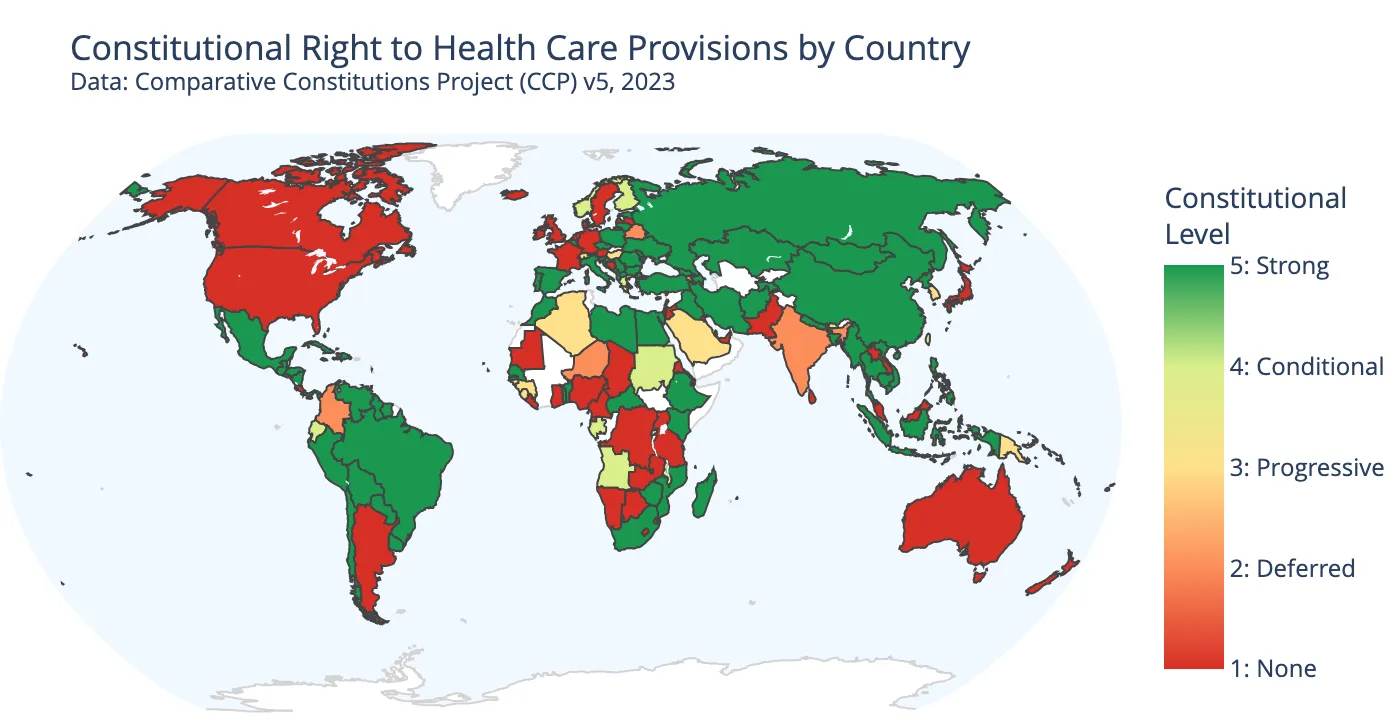
- Read the CCP coders' comments and defined five levels (strong, conditional, progressive, deferred, none), with separate keyword rules for free care, which measures cost rather than duty.
- Merged WHO World Health Statistics 2025 and World Bank indicators, with GDP per capita (purchasing power parity) as the control.
- Computed Spearman correlations, bivariate and partial on GDP, for 30 pairs each, then applied Bonferroni and Benjamini-Hochberg corrections, and repeated the analysis by world region.
- Had ChatGPT write simulated journal peer reviews of the drafts, had Codex add figures, and revised after each round.
- Pulled the 107 cases where the classification depends on a coder comment into a template for two independent reviewers, after a notebook rerun of the automated keywords gave 176 countries instead of 183.
Results
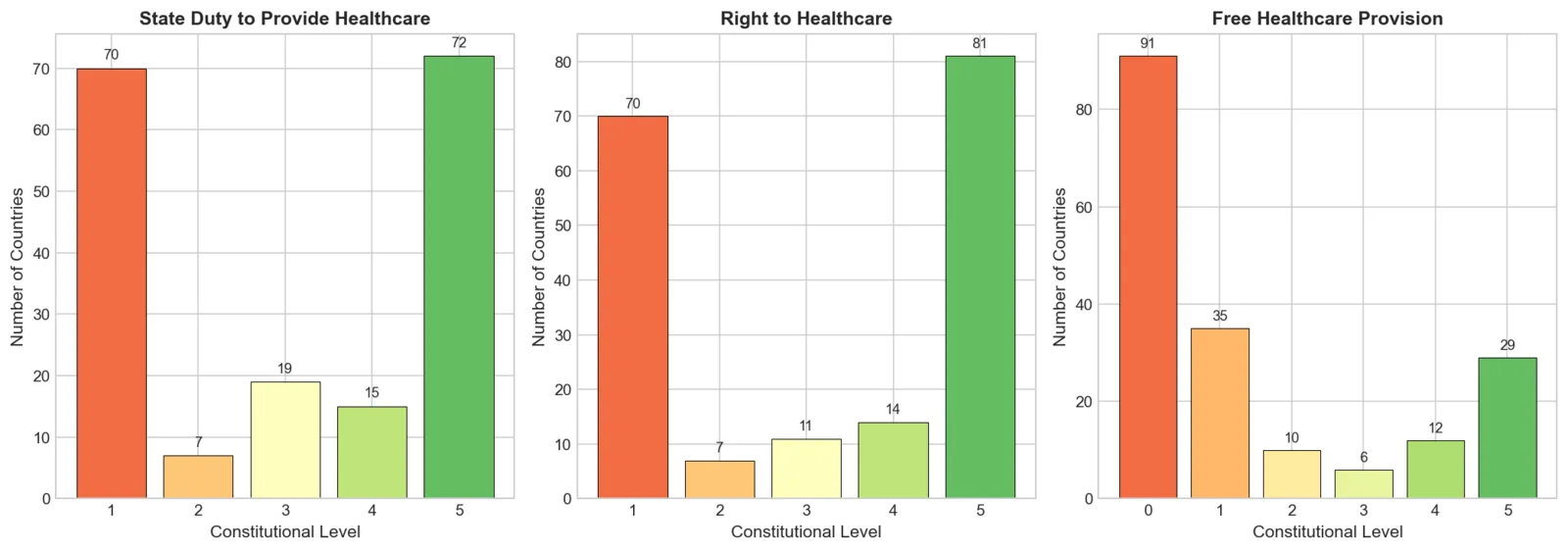
- The yes or no codes overstate strong provisions. CCP codes 92 constitutions (50%) as having a right to health care; 81 (44%) reach the strong level. For the state duty the count goes from 84 to 72, and for free care from 36 to 29.
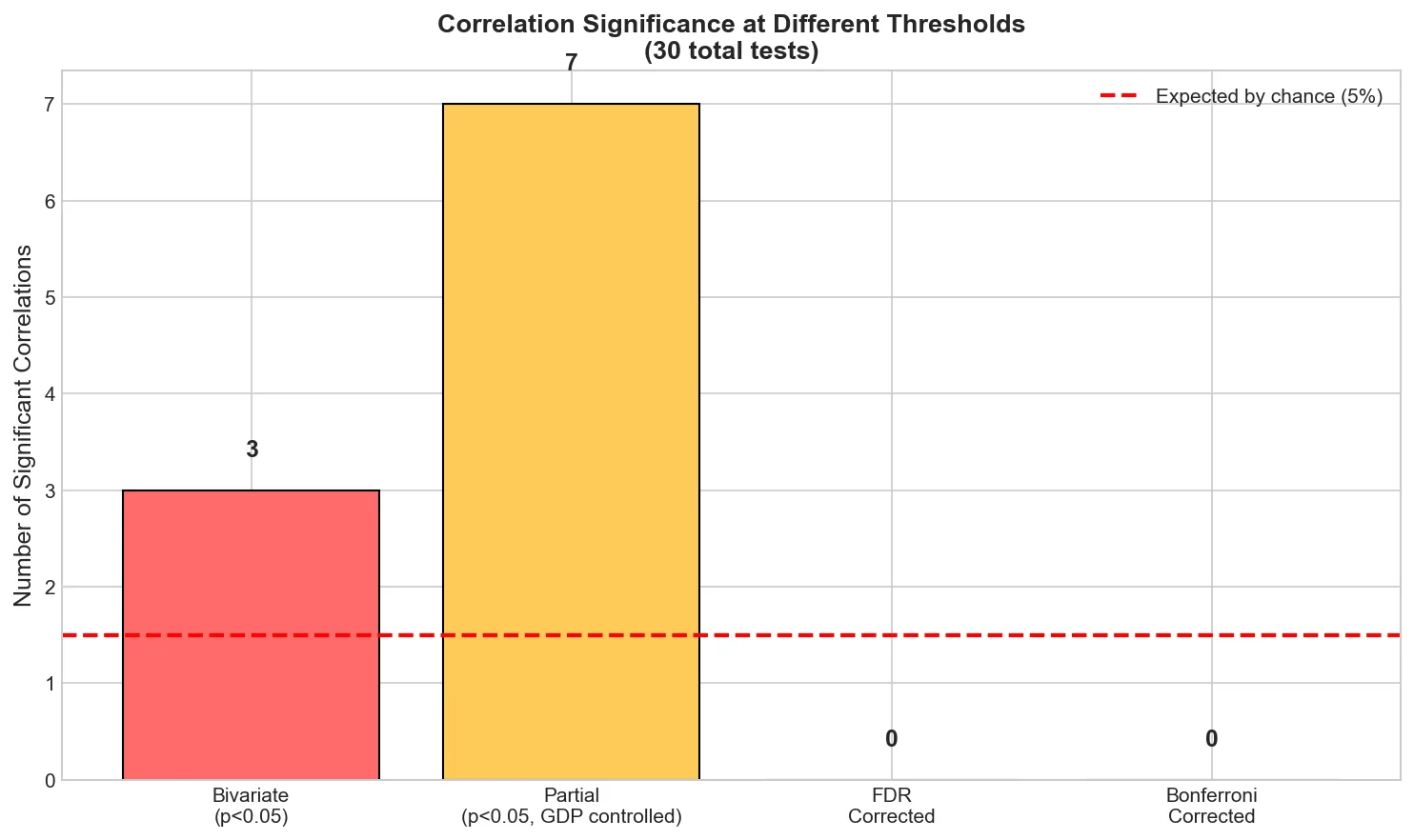
- Of 30 bivariate correlations, 3 were significant at p < 0.05, all in the unexpected direction: stronger provisions with a higher out-of-pocket share of health spending or higher mortality from noncommunicable diseases.
- After controlling for GDP per capita, 7 of 30 were significant at p < 0.05, several in the expected direction, for example a right to health with lower maternal mortality (ρ = -0.188).
- After correction for multiple comparisons (Benjamini-Hochberg false discovery rate, and Bonferroni with a threshold of 0.00167), none of the 30 remained significant.
- By region, Latin America and the Caribbean (29 to 31 countries with data) showed no statistically significant association, while East Asia and the Pacific went the other way: higher constitutional levels with higher infant mortality (ρ = 0.42, p = 0.03, 27 countries, uncorrected).
- Colombia's constitution classifies as "deferred", because its text leaves health to ordinary law, even though its Constitutional Court is among the most active in enforcing the right to health. The scale measures text, not enforcement.
What I learned
Controlling for income changed the picture. Without it, the few significant correlations made stronger rights look harmful; with it, several reversed sign and pointed the expected way. I would put the control into any cross-country comparison of rights and outcomes from the start.
With 30 tests, about 1.5 significant results are expected by chance. When seven nominal hits all vanish under correction, the honest report is a null result.
An AI-made classification that is not documented does not reproduce. Rerunning the keyword rules in a notebook gave a different country count and different level distributions, so I moved to a documented two-reviewer process with an agreement statistic (Cohen's kappa) before any result is final. The human review and the kappa are still to be done, and the manuscript's results still use the earlier classification.
Lab notes
-
I set up a two-reviewer check of the 107 classification cases that rest on coder comments. Claude did the first review; the second, human review is still open.
-
I revised the manuscript after simulated journal peer reviews written with ChatGPT, added figures from Codex (an interactive world map, a sign-reversal chart and a forest plot) and wrote a plain-language guide to the statistics for human rights professionals.
-
I rebuilt the Comparative Constitutions Project's three health questions as a five-level scale for the 183 constitutions in force in 2023, then tested the levels against WHO and World Bank indicators with and without income control, with Bonferroni and false discovery rate corrections, globally and by region.