 Johnattan's Laboratory
A phone scorekeeper for the board game 7 Wonders
I wanted to replace the paper score pad that comes with 7 Wonders. In one evening I built a Spanish-language phone app that adds up the seven scoring categories, works out the science points and lets a whole table share one live scoreboard.

Updated19 Jul 2026
The problem
7 Wonders comes with a paper score pad. I wanted a phone app instead, in Spanish, that keeps the score for up to seven players, does the science arithmetic, and helps new players learn the rules.
What I built
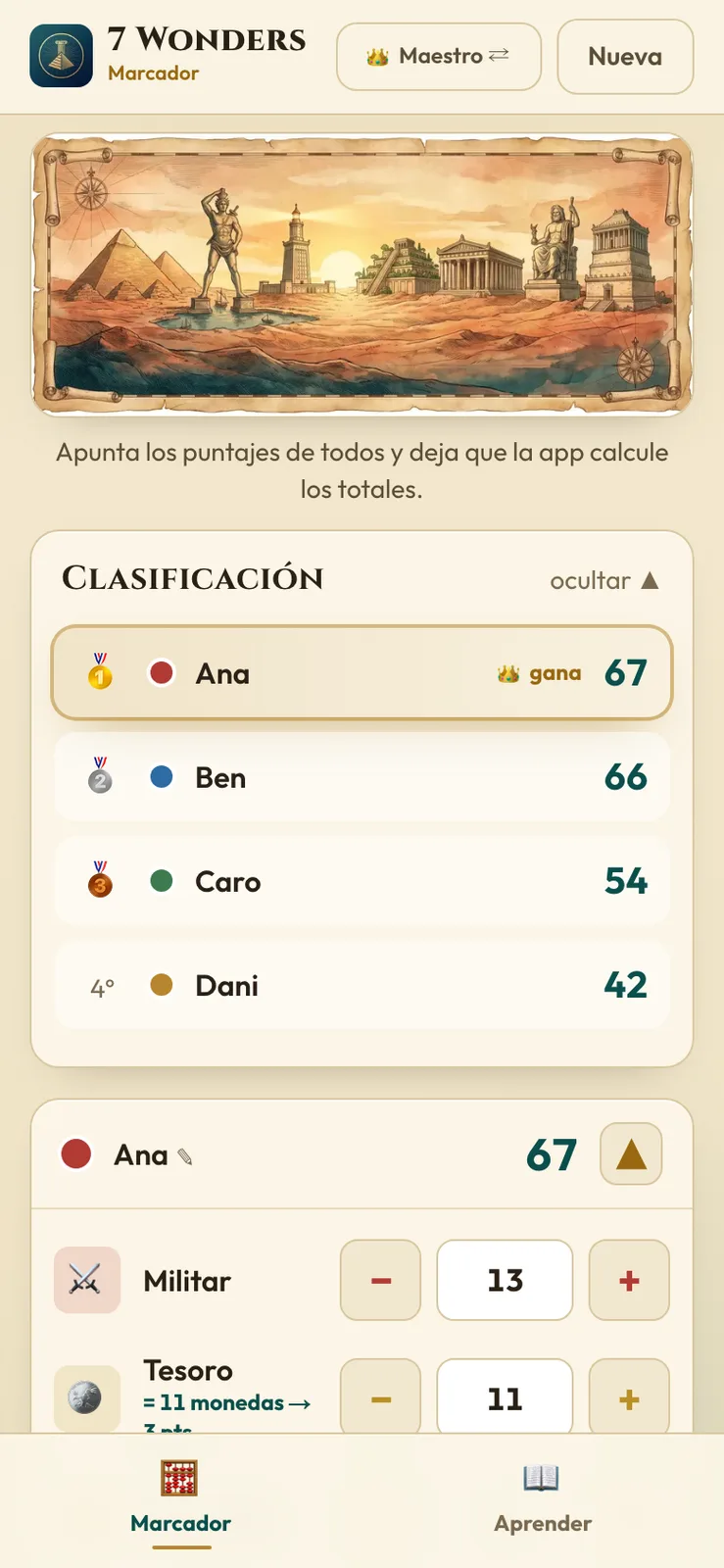
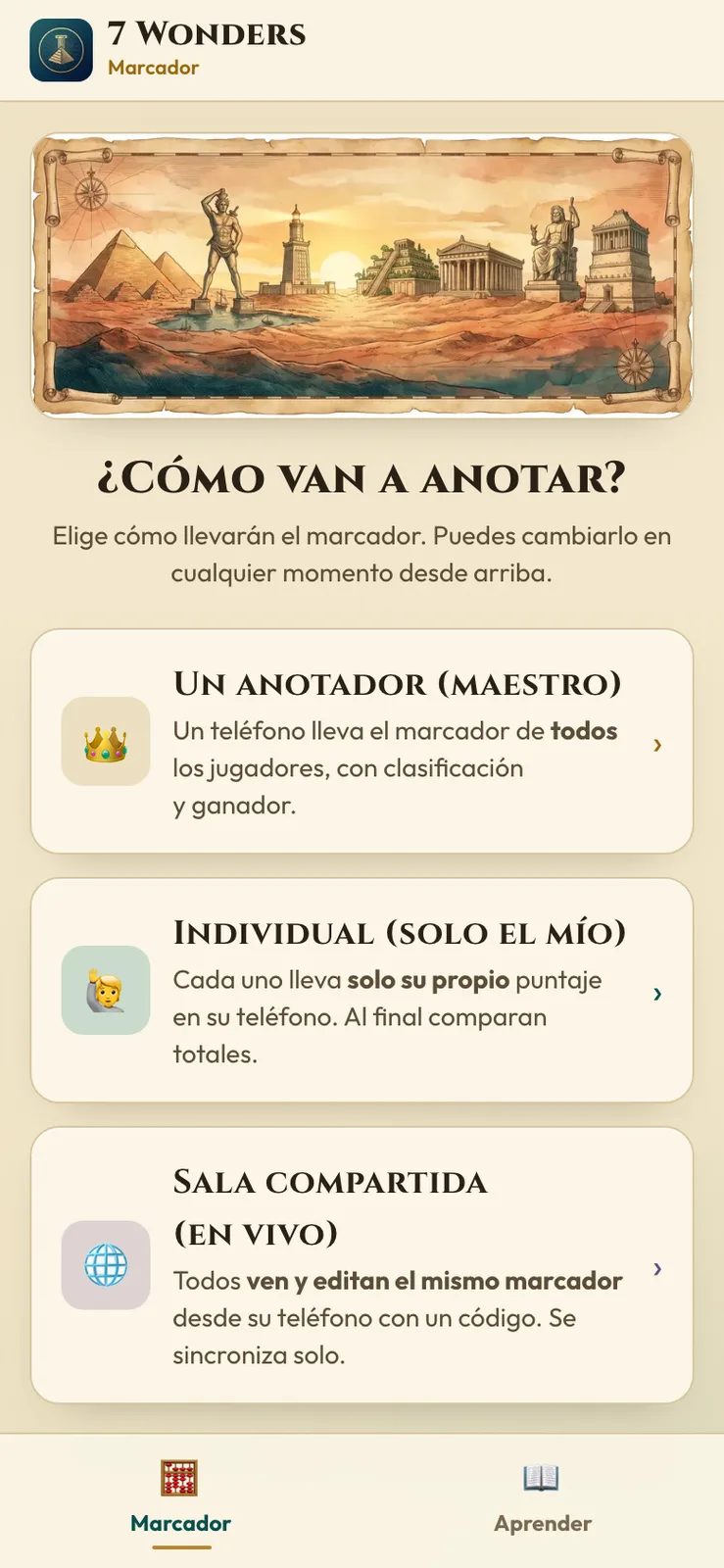
7 Wonders · Marcador is a web app that installs on the phone's home screen and works offline. You choose one of three modes on entry. In Master, one person keeps the score for everyone. In Individual, each player keeps only their own score. In Shared room, one player creates a room and shares a six-digit code, and everyone who joins edits the same scoreboard and sees the others' changes.
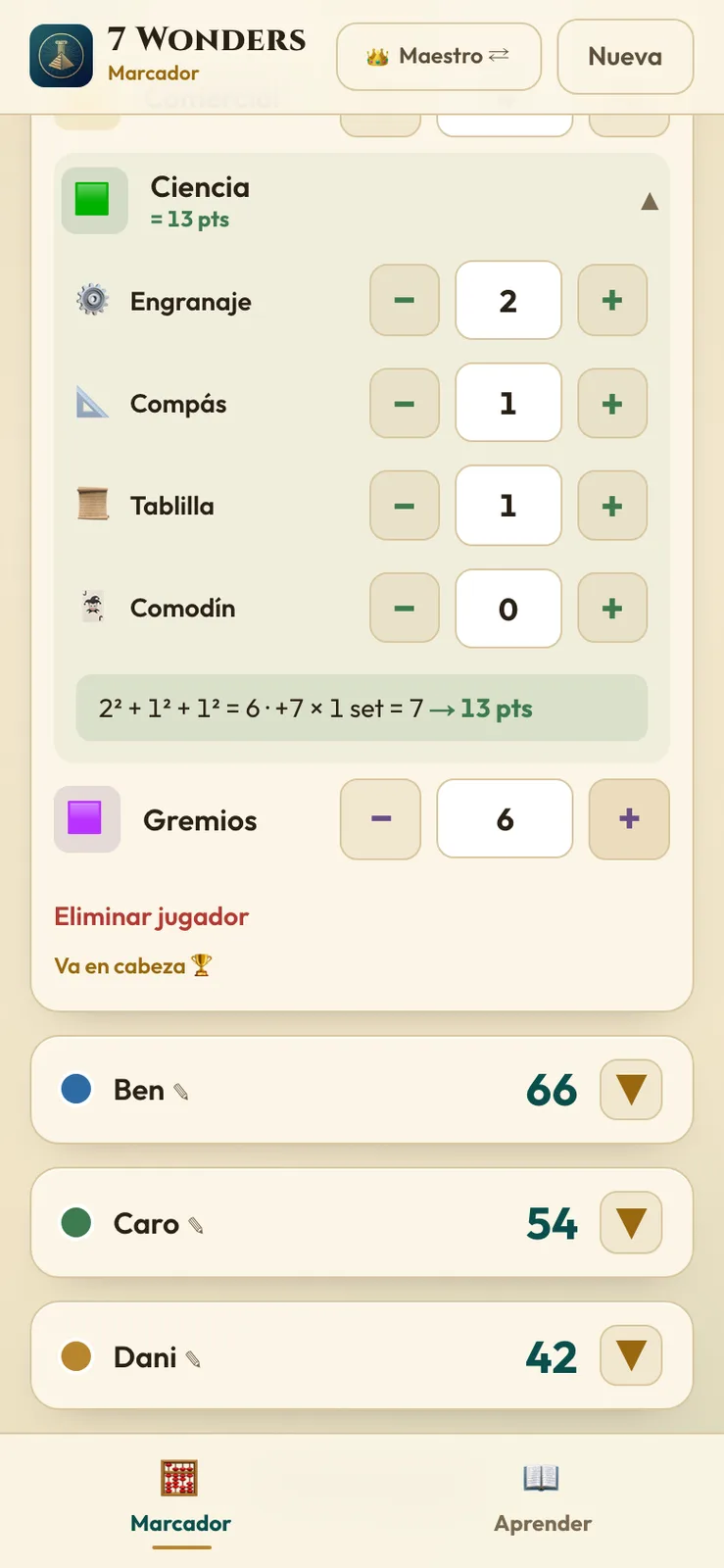
Scores go in under the game's seven official categories (military, treasure, wonder, civilian, commercial, science and guilds). The app totals them, ranks the players live with medals, and breaks ties by coins. Treasure points are the coins divided by 3, rounded down. The science calculator counts each symbol type, scores the square of each count plus 7 points for every complete set of three, and assigns wildcard symbols in whichever way scores best.
A Learn tab summarises the rules and scoring, with tips and a gallery of the seven wonders.
Equipment
- Claude Code Harnesses and agents
- Claude (Opus 4.6 to 5.5) AI models
- Codex CLI Harnesses and agents
- Magnific Design and media
- Gemini (Nano Banana Pro (Gemini image)) AI models
- Next.js Code and infrastructure
- Vercel Code and infrastructure
- Upstash Redis Code and infrastructure
- Playwright Code and infrastructure
How I built it
- I started from a fresh Next.js app (Next.js 16, React 19, Tailwind v4) and kept all the scoring rules in one file as the single source of truth.
- I generated 9 images in Magnific with the Nano Banana Pro model (a hero, the app icon and the seven wonders) and shrank them for the web.
- Codex reviewed the first version; I applied its fixes, then had it review the individual calculator too.
- For the shared room I used Upstash Redis through the Vercel Marketplace. Each player is a separate field in the room's record, so two people editing different players never overwrite each other. Rooms expire 24 hours after the last write.
- A third Codex review, on security and concurrency, led to a hard cap of 7 players, a 16 KiB request limit, cryptographic room codes, and local edits that are kept until the server accepts them.
- I deployed to Vercel and tested the shared room live, sending and receiving changes.
Results
- The app went from an empty Next.js project to a shared live scoreboard in one evening: 13 commits between 18:22 and 23:05 on 19 July 2026.
- It is live at seven-wonders-nu.vercel.app.
- Phones in a shared room check for changes every 5 seconds and back off up to 30 seconds when the connection fails.
- I applied three Codex reviews: of the first version, the individual calculator and the shared room.
What I learned
Offline caching and live data do not mix by default. The service worker served the room's API from its cache, so polling kept returning the first answer and the shared scoreboard never updated. API routes now always go to the network.
Store shared state in pieces that match who edits them. One field per player, instead of one record for the whole table, is what lets several phones edit at once without losing each other's changes.
Lab notes
-
I fixed the service worker, which had been caching the room's API and freezing the sync, hardened the room after a Codex security and concurrency review, and switched room codes to six digits with a numeric keypad for joining.
-
I added a mode chooser (one scorekeeper for the whole table, or a calculator for each player) and a shared room on Upstash Redis, so every phone at the table sees the same live scoreboard.
-
I built the first scoreboard and a Learn tab with the rules, illustrated with AI images of the seven wonders. Then I applied a Codex review, which brought the best assignment of science wildcards, validation of saved scores, accessibility fixes and a service worker for real offline use.